
One of the first things I remember learning about chemistry in middle school (back in the early nineteen nineties) was how to write the electronic configuration of atoms using a sort of arcane code of numbers and letters in a weird progression hard to be rationalized, if not for a diagonal scheme that showed the precise way to fill orbitals with electrons as you moved forward the other big diagram of chemistry, the Periodic Table. It was a pointless lesson at the time, but nonetheless made me feel like I was into the secret complex language of scientists. It was only decades later that I learned that the diagonal rule was proposed by a Mexican scientist, Prof. Jaime Keller.

Professor Jaime Keller was a Mexican polymath who began his scientific career as a chemical engineer, and whose curious mind took him down the paths of reductionism to find ways of understanding the world. From the study of engineering processes he went on to study chemistry, then on to studying electronic structure and quantum mechanics, and then on to the study of Clifford Algebras–even founding the math specialized journal Advances in Applied Clifford Algebras. To this date, he is the youngest professor ever to be hired by the Chemistry School at UNAM at the age of 17. Back when compartmentalization of science was the prevalent way to organize colleges, universities and research centers, he was a chemist, a chemical physicist, a particle physicist, and a mathematician, all at the same time.
In 1956 Prof. Keller published a small paper in Spanish in the journal Ciencia aka Revista Hispanoamericana de Ciencias Puras y Aplicadas, with a graphic method to help writing the electronic configuration of atoms in their ground state titled Diagonal Rule (Regla de la Diagonal), the object of today’s post. It is a simple diagram that follows the properties of spherical harmonics as chosen as the basis of atomic electronic structure and it’s so easy to follow that it is-or at least was-needlessly taught to middle school students.
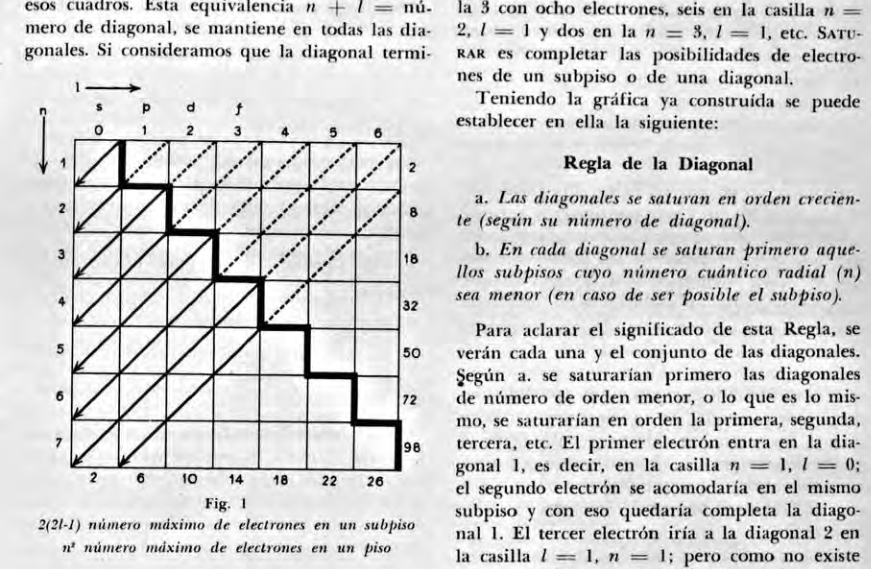
Figure 1 looks quite different from more modern versions in which the full name of each orbital is displayed instead of just the n and l values in matrix form. It is such a simple visualization of a complex concept what makes it elegant. I’m not aware if somebody else came up with the diagonal rule independently at any other point in time or space, but certainly if you google ‘diagonal rule’ you’ll get a myriad of designs about the same object.
Aside from a dedicated scientist and teacher, Prof. Keller was deeply involved in the academic life of the National University of Mexico (UNAM), being the director of the Chemistry School during the seventies, a position he exercised with a stern character while at the same time embodying the absentminded professor persona. During that time, my father worked at the Chemistry School running the IT services (long before they were called IT). He tells me Prof. Keller would often travel back from a conference or from visiting one of his many international collaborators carrying magnetic tapes with data or codes, that when handed to the young IT workers would be entirely blank on account of having them exposed to x-ray detectors at airports.
Mentioning all his awards and recognitions, his honorary degrees and positions around the world, requires a full post of its own. I think it’s safe to say Prof. Keller was a pioneer of quantum chemistry in Mexico, but I’m afraid our lack of memory and documentation is hindering the new generation of Mexican scientists from remembering and honoring him properly. I stand by my proposal of naming an award in physical chemistry after him, but the vocal reluctance of some colleagues makes me realize I’m also unaware of other aspects of his academic life, just the same way I was oblivious to the fact that the Diagonal Rule was his invention; perhaps my chemistry teacher back then was too.

Oziewicz, Z. In Memoriam Jaime Keller (1936-2011), Adv. Appl. Clifford Algebras 21 (2011), 1-11
So now you know where the Electronic Configuration X-Mas Chemistree comes from. If you’re aware of any other origin stories for it, please share them in the comments section. I wish all readers and subscribers a happy new year. Thanks for sticking around in what seems now like the blogosphere’s afterlife.
 Dr. Joaquin Barroso's Blog
Dear Dr. Barroso, Can you suggest how to converge the following TD-DFT computation.
#p m062x/6-311++g(2d,p) gfinput opt TD=(NStates=10,singlet,root=1) scrf=(pcm,solvent=acetonitrile)
The following converge without much problem. #p rcam-b3lyp/6-311++g(2d,p) gfinput opt TD=(NStates=10,singlet,root=1) scrf=(pcm,solvent=acetonitrile)
Any help will be highly appreciated.
Gracias. Muy bien relato y sí sería bueno que algún premio académico importante llevara su nombre. Solo un detalle: nunca fue director de la Facultad de Química
https://vitsb1.blogspot.com/2023/12/what-after-engineering-common-question.html