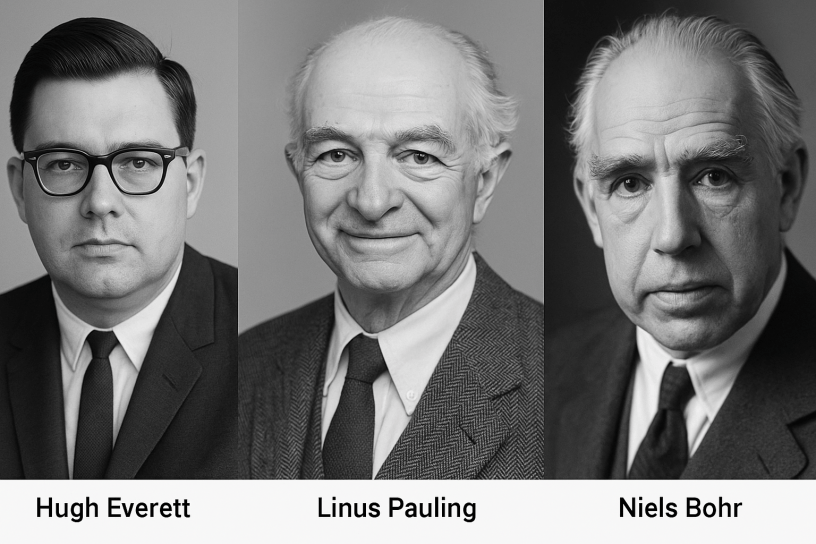
2025 was declared by UNESCO as the International Year of Quantum Sciences, bringing a lot of celebrations, however much of the discourse is dominated by physicists and quantum technologists, some of which proclaim the dawn of the new “quantum revolution”. Yet, amid the excitement, I can’t help but notice that quantum chemistry remains underrepresented, despite being the discipline that has arguably done the most to turn quantum mechanics into a practical, predictive science. Physicists tend to be closer to philosophers than chemists at the core of the debate regarding the interpretation of Quantum Mechanics. While debates over the Copenhagen v the Many Worlds interpretation abound in physics symposia and some popular science outlets, chemists have navigated around the interpretation of quantum mechanics in a quiet and pragmatic manner.
Few scientific disciplines are as deeply rooted in quantum mechanics as quantum chemistry. And yet, when it comes to foundational interpretations of quantum theory, quantum chemistry has historically remained on the pragmatic sidelines. Perhaps due to the way it is taught in the undergrad curricula, where there is a heavy emphasis on the early historical development of atomic models, quantum chemistry aligns more naturally with Copenhagen, but not without subtle resonances with Many Worlds.
The Copenhagen interpretation, emphasizes the collapse of the wavefunction and the priority of measurement, and this view is compatible with the standard workflow of quantum chemistry. As I tell my students, the name of the game is solving the time‐independent Schrödinger equation for stationary states, interpreting the square modulus of wavefunctions as probability densities, and comparing expectation values to experimental observable quantities. Quantum chemistry has flourished precisely because this interpretation provides a clear operational link between mathematical formalism and measurable chemical properties.
Thus, we don’t regard the wavefunction as a literal description of physical reality, but rather as a powerful computational device for predicting outcomes. Electronic structure methods such as Hartree–Fock, configuration interaction, or coupled cluster theory all assume that what matters extracts expectation values from a single, normalized wavefunction. Quantum chemical software embodies this Copenhagen pragmatism: computations end when one obtains a well-defined energy, dipole moment, or excitation spectrum—quantities stemming from the collapse of the wavefunction upon “measurement.”
In contrast, the Many Worlds (or Everett) interpretation considers the wavefunction as a complete description of a multiverse branching with each interaction. I think that eliminating the element of an observer or an active measurement is what appeals to cosmologists and relativists.
I think this is the point where quantum chemistry tips towards Copenhagen; since our main goal is not to explain reality or the emergence of reality, but to predict chemical properties within controlled approximations. Therefore, the many worlds interpretation has little resonance with the vision chemists have of the “electronic” (that’s our subatomic) reality.
For example, entangled superpositions of electronic states between large molecular aggregates, such as those found in potosynthetic energy transfer systems, are treated as coherent wavefunctions evolving into the energy separated final state with decoherence playing the role of “the branching”. Similarly, excited-state dynamics treat superpositions of many possible pathways simultaneously, which is not that different to a Many Worlds evolution of a wavefunction. I strongly believe that quantum computing will shed light onto this debate, but I haven’t read enough to make an informed comment.
Chemistry is messy. Nuclei and electrons form complicated arrangements in various conformations, therefore the conceptual simplicity of the Copenhagen interpretation of using a wavefunction as a tool for calculating expectation values (measurements) is very appealing. However, it’s not like chemists are completely attached to the philosophical view of the wavefunction collapse; in the end, since both interpretations yield the same results the only difference might be just of a storytelling nature.
Quantum chemistry has a unique place in the quantum sciences: It is ambitious in the complexity it wants to cover, yet computationally expensive. While the Copenhagen interpretation seems natural to it due to its historical development and methodology clarity, our field is increasingly approaching conceptual territories where a Many Worlds narrative could be more intuitive, e.g. the treatment of entanglement and decoherence in complex systems or aggregates.
In the end, quantum chemistry is more loyal to its predictive accuracy and practicality than to any philosophical school. Sure, this is a pragmatic stance not far from the ‘shut up and calculate‘ vision, but one that lays bridges between theory and experiment.
 Dr. Joaquin Barroso's Blog
Excellent post.
The theistic view of Quantum Mechanics is even less considered because so few theists write on this topic. But the Many Worlds view is completely compatible with theistic interpretations. In fact, Occam’s razor (to minimize causes) favors the theistic view. Why posit “many” worlds when only two worlds are needed – the physical and the spiritual.
In Forensic Science (and science in general) we seldom use the word “prove”. We likely posit that the data is consistent with this or that theory. And experiments that clearly violate locality are consistent with a God who plays the universe like a violin.
17 … in him all things hold together. [Colossians 1:17 ESV]
3 The Son is the radiance of God’s glory and the exact representation of his being, sustaining all things by his powerful word. … [Hebrews 1:3 NIV]
God is not limited by the speed of light and he “lets us play” with the university through our free will. When we collapse the wave function through measurement, he is pleased to instantly play the corresponding note on the other wave function. In this way we both participate in the world, together.
What a beautiful thought.
^universe, not university! Ugh! LOL
I’m glad you liked it. While I’m not religious in any way, I wont deny there is room for theological interpretations of reality.
Thanks for commenting