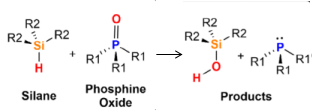
Some of the most useful reactions in a synthetic chemist’s toolbox — the Wittig, the Appel, the Mitsunobu, the Staudinger, have a common problem: they yield stoichiometric piles of phosphine oxide as waste, which can pose an environmental hazard. R₃P=O is thermodynamically very stable, and turning these reactions into catalytic processes relies on our ability to push that oxygen back off and regenerate the phosphine in situ. Among the ways to do it, hydrosilanes are the pragmatic favorite choice: they are relatively cheap, tunable, and they hand the oxygen over as an innocuous silanol.
But which silane? This is where the literature gets frustrating and at the same time interesting. Over the years, both a less acidic silane like a diphenyl silanol and a highly acidic one like Cl₃SiH have been reported to outperform the workhorse Ph₂SiH₂. Two opposite ends of the acidity scale beating the middle. That’s a seemingly a contradiction begging for an explanation. Either “acidity” is doing a poor job of describing what actually matters, or we have been telling ourselves a polished story that the electrons never agreed to.
So our joint student Leonardo “Leo” Lugo-Fuentes (soon to be Dr. Lugo-Fuentes), together with my good friend and colleague Dr. J. Oscar C. Jiménez-Halla (University of Guanajuato), set out to settle it the unglamorous way: not by cherry-picking one lucky system, but by running a whole family of phosphine oxides and silanes through the same computational lens and asking what the numbers actually say.
Two partners, two completely different jobs
The rate-limiting act in this reduction is the hydrogen transfer via a four-membered transition state in which the Si–H bond breaks, the P–H bond forms, and a σ(O–Si) bond forms in a concerted fashion. We dissected that transition state with the distortion–interaction / activation strain model and with NBO analysis, splitting the energy into two intuitive pieces: how much each fragment has to deform to reach the TS (distortion), and how much the two distorted fragments stabilize each other once they’re there (interaction).
The main result, the one that got us most excited, is that the two reacting partners are governed by entirely different physics.
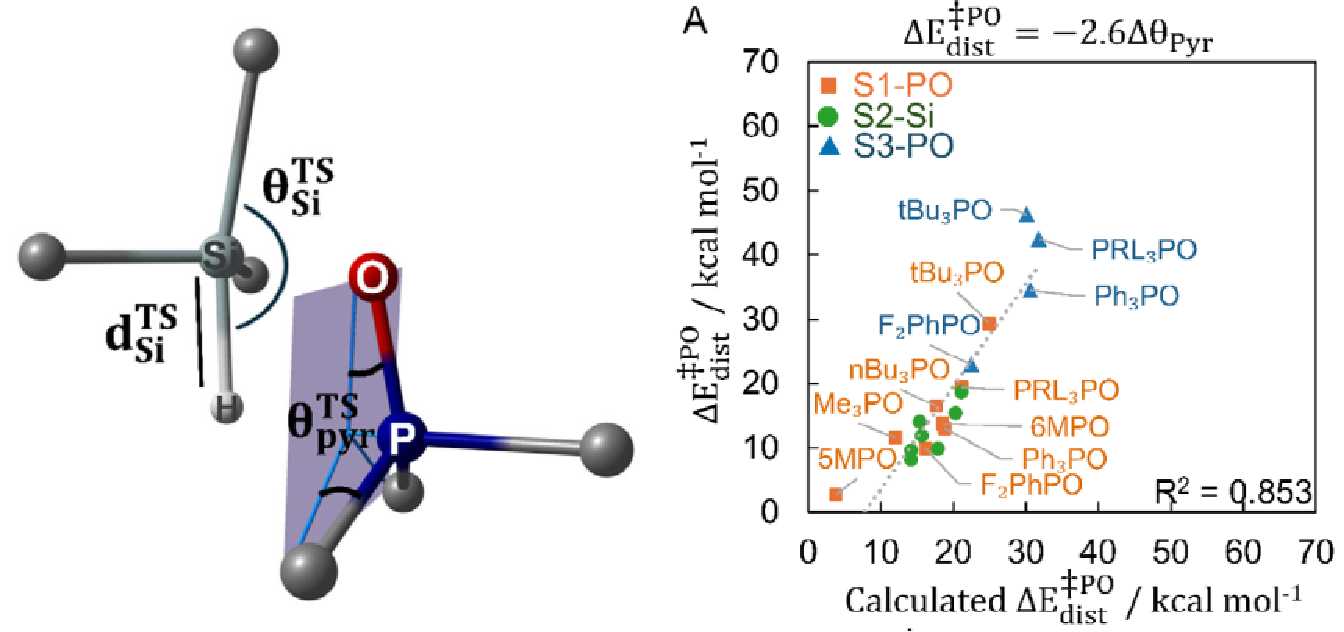
For the phosphine oxide, the barrier is a story about distortion. The phosphorus has to flatten out and climb toward a trigonal-bipyramidal geometry, and the easier that is, the lower the barrier. We can capture this with a single geometric descriptor, the pyramidalization angle (as previously defined by Haddon), which tracks the distortion energy remarkably well (Figure 1). A rigid five-membered cyclic oxide (5MPO) barely has to move and reduces beautifully (ΔG‡ ≈ 20 kcal/mol); the tert-butyl monster tBu₃PO has to fight its own bulk to get there and sits at a miserable ~39 kcal/mol. If you can’t build a cyclic phosphine oxide, geometry is working against you and there’s not much the oxide can do about it.
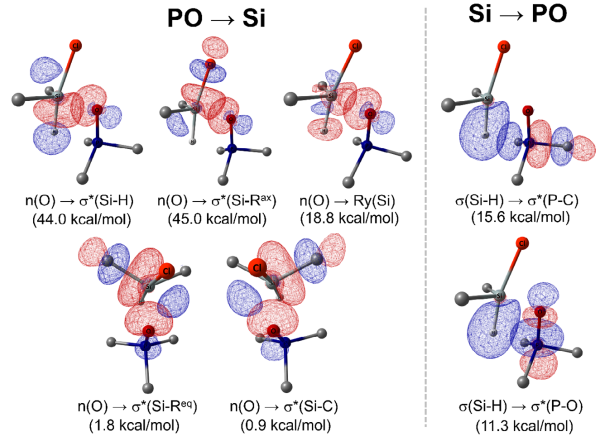
For the silane, distortion is almost beside the point — the barrier is dictated by the interaction energy, and that interaction is a specific, nameable orbital event: donation from the phosphine-oxide oxygen lone pair, n(O), into the antibonding orbitals of the silane, σ*(Si–H) and σ*(Si–R). The better the silane can accept that density, the lower the barrier. That’s the whole game.
So what about acidity? Here’s the part that solves the paradox, and it’s my favorite part because it’s the same lesson I keep coming back to on this blog: a single descriptor can hide the actual chemistry. Just as a bond critical point doesn’t make a bond, a low pKa doesn’t make a good reducing silane.
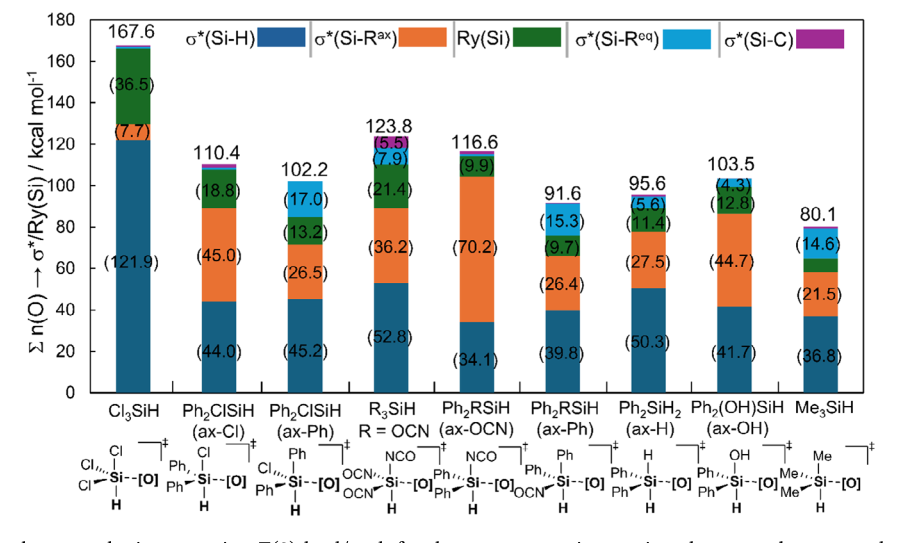
What we found is that the substituent’s job is not to be “electron-withdrawing” in some global, bulk sense — it’s to polarize the Si–R bond and enhance the acceptor character of that specific σ*(Si–R) orbital, especially when it sits axial to the transferring hydrogen, where its overlap with n(O) is best. And once you frame it that way, the contradiction evaporates. Put Cl in the axial position and the n(O)→σ*(Si–Rax) donation is huge (~45 kcal/mol). Put OH there instead (an electron-donating group by every undergraduate rule) and you get essentially the same thing (~45 kcal/mol), and a barrier as low as the chlorosilane’s. OH and Cl look like chemical opposites, yet both polarize their Si–R bond hard enough to make σ* a strong acceptor. The acidity axis was a coincidence of correlation; the polarization of the axial σ* is the cause.
Meanwhile, the fully alkyl silane Me₃SiH is hopeless (ΔE‡ ≈ 20 kcal/mol at the same level) not because it’s insufficiently acidic, but because it simply has no low-lying, accessible σ orbital* for the oxygen to interact with. There’s nothing to donate into.
A design rule that falls out of the physics
When we put those two pieces of the puzzle together we get a full rationalization and design rules to come up with reducing agents for that phosphine oxide. When you can cyclize the phosphine oxide, do — geometry hands you a low barrier. When you can’t, redesign the silane: you want at least one small, electronegative substituent directly bonded to silicon — OH, OCN, or Cl — sitting axial, paired with two aryl groups, as in a Ph₂RSiH. Small enough to avoid the steric penalty that kills adduct formation, electronegative enough to polarize the Si–R bond, and thereby to open up a proper acceptor orbital for the oxygen lone pair.
This is, to me, the nice thing about doing computational chemistry comparatively rather than one hero-system at a time — the same move Leo, Oscar and I leaned on in our recent FLP water-splitting paper. Any one transition state can be rationalized after the fact. It’s only when you line up a whole series under one method that the real variable steps out from behind its proxy and here, that means trading a fuzzy appeal to “acidity” for a concrete, orbital-level design principle. Which is exactly the kind of thing a synthetic chemist trying to close a catalytic cycle can actually use.
You can read the whole thing, Open Access, at Eur. J. Inorg. Chem. 2026, e70282, DOI: https://doi.org/10.1002/ejic.70282. As always, my hat off to Leo for the heavy lifting, and thanks to Oscar and to Rong Shang for a great collaboration. Thanks for reading, commenting, and sharing.


You have made it a lot easier for understanding the concepts involved to a lesser expert in the domain. This too without taking too much time and heavy duty methodology (in publication).
Science is best when communicated well😊.